
Articles
(Brief Introduction to High Performance Liquid Chromatography (HPLC
posted : 7 بهمن 1399
By: Kianshar D research team
HPLC stands for High performance liquid chromatography or high pressure liquid chromatography. HPLC is a commonly used method for separation of compounds in a mixture in analytical chemistry or biochemistry so as to identify, quantify or purify them. There are two modes of HPLC according to the nature of the used mobile and stationary phases, Normal Phase (NP) HPLC or Reversed Phase (RP) HPLC. RP HPLC is the most used mode which provides dynamic retention of compounds possessing hydrophobic and organic functionality. A combination of hydrophobic and van der Waals type interactions between all the target compound and both the stationary and mobile phases enable the retention of these compounds by reversed phase.
HPLC in practice
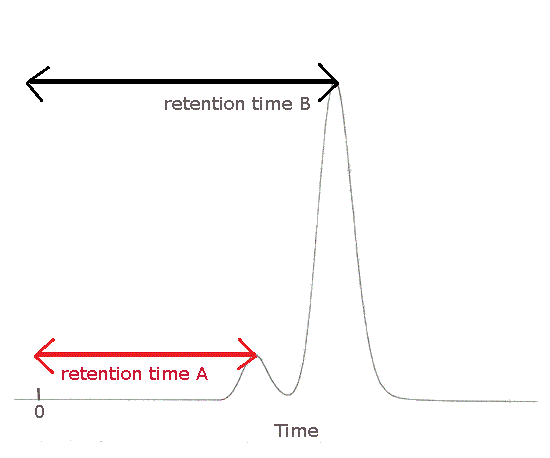
A small amount such as 10 μl of the sample mixture is injected into the stream of mobile phase using a special injection valve. The sample mixture is delivered to the separation column which is the stationary phase in HPLC method. According to the separation needs many different types of columns with sorbents of varying particle sizes and surfaces are available. The sample mixture interacts with the sorbent of the stationary phase while moving through the column at varying velocities. The velocity of each component in the sample mixture depends on 3 main factors: 1- composition of the mobile phase. 2- Nature of the stationary phase 3- chemical nature of the sample Interactions between the column sorbent with the compounds of the samples result in separation of the analytes which emerge from the column one after another at different times. The time at which an analyte comes from the column is known as its retention time. The retention time is measured upon specific conditions and considered as the important identifying characteristic of an analyte.
Figure 1: Retention time in a chromatogram
Nature of the column sorbent which is known as stationary phase is hydrophobic or polar. The most used mobile phases include any miscible combination of water and organic solvents such as methanol or acetonitrile. It is also possible to use water free mobile phases The aqueous part of the mobile phase might contain acids like phosphoric, formic, or trifluoroacetic acid or salts to enable the separation of the sample components.
There are two methods of elution in HPLC:
1- Isocratic elution
2- Gradient elution
In isocratic elution the composition of the mobile phase keeps constant during chromatographic analysis whereas it varies in gradient elution. The isocratic approach is appropriate for the separation of the sample components that are similar in their affinity for the stationary phase. In the gradient approach, the composition of the mobile phase differs from low to high eluting strength. The eluting strength of the mobile phase affects the retention time of analytes in sample mixture. More eluting strength in gradient elution results in more effective and fast elution.
Figure 2: Gradient elution vs isocratic elution

The separation process in HPLC is similar to the liquid-liquid extraction process except that the liquid-liquid extraction is a continuous process, while the HPLC separation is a stepwise process.
An expert HPLC user chooses the mobile phase composition according to the intensity of interactions between sample components and the stationary phase whereas performs the trial partitioning processes to determinethe exact HPLC method that would provide adequate separation.
Iranian HPLC manufacturer
Among all the famous and strong HPLC manufacturers, Kianshar D (www.kianshardanesh.com ) is a knowledge based company which introduced its first HPLC system in 2015 with trade mark of "DanChrom" . Actually the DanChrom HPLC systems are emerged from the difficulties produced by US sanctions against Iranians in the second decade of 21rst century. Many scientists and technicians strived hard for more than 4 years to produce DanChrom HPLC systems which are comparable with the most advanced ones in the world. Today the DanChrom HPLC products include:
1- A1 Isocratic HPLC system
2- A2 Quarternary gradient HPLC system
3- SP1 Semi preparative HPLC system with isocratic pump
4- SP2 Semi preparative HPLC system with quaternary gradient pump
Some Benefits of HPLC
Some of the key benefits of HPLC systems are as follows:
1 - To enable the easily analysis of most the non-volatile organic compounds in room temperature.
2 - Access to different kind of detectors for analyzing the compounds with various chemical structures.
3 - fast and easy to use
4 - affordable price Some
Applications of HPLC
HPLC enables identifying, quantifying and purifying a particular analyte or compound. This technique is commonly used for a great number of applications such as:
1 - Identifying of toxins and organic compounds in water samples
2 - Detection of impurities in pharmaceutical products
3 - Preconcentration and separationof trace components from plant extractions
4 - Determination of Therapeutic Drug Monitoring (TDM)
5 - Determination of blood amino acids for investigation and diagnosis of metabolic diseases such as phenylketonuria ( PKU ) , homocystinuria ( HCY ) and …